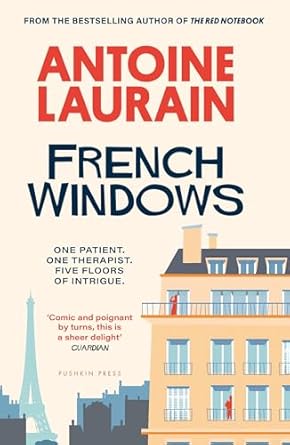
Antoine Laurain is one of my favourite writers. I pick up every one of his books expecting to love it, and he almost never disappoints. French Windows has all the elements that I associate with his writing. It’s charming, quirky, and interesting. But this book has the added element of murder and mystery. You never quite know where it is going, but the writing keeps you hooked until the big reveal at the end which is most unexpected.
The two main characters in the story are Dr Faber, a psychoanalyst, and Nathalia Guitry, who is one of his patients. She’s a young woman, in her early thirties, who has just started coming to him for therapy. We meet both characters in their first therapy session.
Dr Faber asks her why she’s come to him, and she replies that she’s there because she’s screwed up her life. This is something that patients tell him all the time. He asks more questions. She tells him that she’s a photographer who’s unable to take pictures any more, and she feels stuck because she’s no longer able to do something that she loves.
They talk a little more, and then he asks her about the last thing that she’d photographed. She tells him that it was a murder scene. That feels designed to throw him, so he ignores it, the session ends, and he’s not sure he’ll ever see her again. But she shows up the next week. He tries to get her to talk, but she’s not very communicative. She says she’s not doing anything much these days. She stays home, watches her neighbours come and go and that’s it.
Dr Faber realises that Nathalia has something on her mind, something that’s bothering her so much that she’s unable to go on with her life. She did mention witnessing and photographing a murder, but he’s doesn’t give that statement any credence. He assumes that she said that to try to shock him.
She has a problem, but she’s unwilling or uncomfortable talking about it. So he devises an exercise for her, one that he hopes will make her open up a little. When she mentioned that she watches her neighbours, she said that her apartment faces the north-wing of the building she lives in, and that there five floors on that wing with one apartment on each floor.
So he tells her to write something about these neighbours of hers, real or imagined, one piece of writing per floor, per week. He will read what she’s written and then they’ll talk. He hopes that she will slowly reveal something of herself as she writes about her neighbours week after week. He thinks that writing in this way might get her past the creative block that she’s experiencing.
What follows is a series of stories about her neighbours. Nathalia writes well, with lots of description and detail. It feels as if she’s writing about real people, but even if she knew their names, and what they do, she couldn’t know all those intimate and personal details, could she?
Dr Faber looks up each person that Nathalia writes about and finds that they are all real people and that a lot of what Nathalia has written about them is true. None of the stories give him any clue as to what is happening with his patient and he starts to wonder if this exercise is doing any good at all. But he decides to stick with it.
The bulk of the novel is made up of the stories that Nathalia writes. They are all fascinating and so worth reading. They’re unrelated stories, each independent of the other, but in the context of the book, they make an interesting whole.
Nathalia does reveal something important by the time she gets to the end of this writing exercise, but in the interest of not giving out any spoilers, I will not say what that it is. This is a short novel at 175 pages, but Laurain packs a lot into them. This is a very good read.
 between the pages