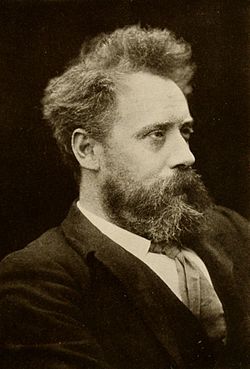
William Ernest Henley was born in Gloucester, England, in 1849. He was a poet, critic, and editor who introduced the early work of many of the great English writers of the 1890’s. He was the son of a Gloucester bookseller and a pupil of the poet T.E. Brown.
Henley contracted a tubercular disease in his youth that later necessitated the amputation of one foot. Forced to stay in an infirmary in Edinburgh for twenty long months, he began writing impressionistic poems (some in free verse) about hospital life that established his poetic reputation.
Some of these were published in The Cornhill Magazine in 1875. The editor of the magazine liked the poems, and he went to visit Henley in the hospital. He brought along with him, another contributor to the magazine, Robert Louis Stevenson. The two writers became good friends. Stevenson later modelled his character, Long John Silver in Treasure Island, on his crippled, hearty friend.
Henley kept writing poetry, but he wrote that he “found himself about 1877 so utterly unmarketable that he had to own himself beaten in art and to addict himself to journalism for the next ten years.” He became the editor of The Magazine of Art where he stayed from 1882 to 1886. During this time, he championed the artists James McNeill Whistler and Auguste Rodin. He also worked on the ninth edition of the Encyclopedia Britannica. This particular edition has been called the scholar’s encyclopaedia.
Henley became editor of the Scots Observer of Edinburgh in 1889. The journal was transferred to London in 1891 and became known as the National Observer. This was a literary newspaper, which, according to Henley, had almost as many writers as it had readers. But it was an important publication in literary circles. Though conservative in its political outlook, the paper was liberal in its literary taste and published the work of Thomas Hardy, George Bernard Shaw, H.G. Wells, James Barrie, William Butler Yeats, and Rudyard Kipling.
As an editor and critic, Henley was remembered by young writers as a benevolent bully, generous in his promotion and encouragement of unknown talents and fierce in his attacks on unmerited reputations. Henley published two volumes of his poetry, A Book of Verse in 1888 and The Song of the Sword in 1892.
Invictus, (1875), his most famous poem, is a testament to his irrepressible spirit.
Out of the night that covers me,
Black as the pit from pole to pole,
I thank whatever gods may be
For my unconquerable soul.
In the fell clutch of circumstance
I have not winced nor cried aloud.
Under the bludgeonings of chance
My head is bloody, but unbowed.
Beyond this place of wrath and tears
Looms but the Horror of the shade,
And yet the menace of the years
Finds and shall find me unafraid.
It matters not how strait the gate,
How charged with punishment the scroll,
I am the master of my fate:
I am the captain of my soul.
…
Sources:
The Writer’s Almanac
Encyclopaedia Britannica
 between the pages